
Many businesses believe they know their customer. They can describe industries, job titles, company sizes, or revenue ranges. They may even have buyer personas documented somewhere inside a slide deck.
Yet conversions remain inconsistent.
Lead quality fluctuates. Sales cycles stretch. Campaign performance feels unpredictable. Marketing generates interest, but revenue does not follow proportionally. In most cases, the issue is not lead generation. It is clarity.
When you fail to properly define ideal customer profile, marketing becomes broad instead of precise. Precision drives conversion. Broadness drives noise.
An ICP that actually converts is not demographic guesswork. It is strategic architecture.
Why Defining Your ICP Is More Than a Marketing Exercise
To define ideal customer profile effectively, you must go beyond surface-level characteristics.
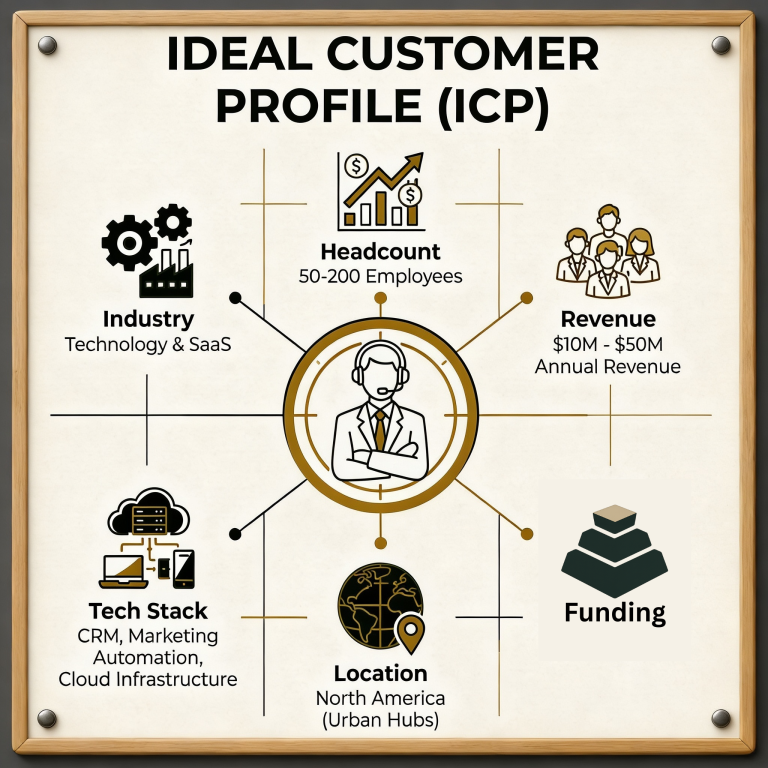
An ICP is not simply a list of industries or company sizes. It is a structured understanding of the organizations or individuals most likely to experience measurable success with your solution.
When businesses skip this depth, marketing attracts interest but not intent.
If you do not clearly define ideal customer profile parameters, your messaging becomes diluted. Campaigns cast wide nets. Sales teams qualify aggressively rather than strategically.
Conversion instability often begins here.
Precision in targeting is the difference between predictable growth and constant recalibration.
The Cost of an Undefined ICP
When you fail to define ideal customer profile correctly, several consequences emerge.
First, acquisition costs increase. Broad targeting leads to unqualified traffic. Marketing teams spend more to reach audiences that will never convert.
Second, sales teams invest time in low-probability conversations. This reduces efficiency and slows revenue velocity.
Third, messaging becomes inconsistent. Without a clearly defined audience, value propositions shift depending on the campaign.
Over time, this fragmentation leads to positioning confusion.
An undefined ICP creates structural instability.
Define Ideal Customer Profile: Start With Revenue Reality
The most effective way to define ideal customer profile is to examine your highest-value customers.
Look at the accounts that:
- Converted efficiently
- Produced strong lifetime value
- Required minimal support friction
- Referred others
- Experienced measurable success
Patterns will emerge. Do they share operational challenges? Growth stages? Leadership structures? Decision-making dynamics?
ICP clarity begins with evidence, not assumptions.
Too often, organizations define ideal customer profile aspirationally rather than realistically. They pursue logos or industries that appear attractive but do not align with proven performance patterns.
Data should anchor ICP definition.
Beyond Demographics: Behavioral and Strategic Fit
A converting ICP includes more than firmographics.
To truly define ideal customer profile, you must also examine behavioral alignment.
Consider:
- Buying urgency
- Budget authority
- Risk tolerance
- Innovation openness
- Implementation readiness
Two companies of identical size and industry can perform very differently based on internal culture and strategic priorities.
Conversion depends not just on who they are, but on how they operate. An ICP that converts integrates structural fit with behavioral readiness.
Define Ideal Customer Profile and Align Messaging
Once you define ideal customer profile criteria, messaging must reflect it.
If your ICP prioritizes efficiency, your messaging should emphasize measurable time savings. If your ICP values risk reduction, your content should highlight compliance, stability, and predictability.
When messaging aligns tightly with ICP pain points and priorities, conversion rates improve naturally.
When messaging remains generic, prospects hesitate.
The clarity you establish while you define ideal customer profile becomes the backbone of your value proposition.
Marketing and Sales Must Share ICP Ownership
Defining your ICP is not solely a marketing responsibility.
Sales teams provide real-time feedback about objections, deal velocity, and buyer hesitation. Marketing provides targeting insights and campaign performance data.
If these teams define ideal customer profile independently, misalignment occurs.
Shared ICP ownership ensures:
- Consistent qualification standards
- Accurate reporting
- Cohesive messaging
- Reduced friction in handoffs
When both teams align around the same ICP, conversion predictability increases.
The Role of ICP in Conversion Rates
If you are questioning why conversion rates fluctuate, revisit whether you truly define ideal customer profile with precision.
An accurate ICP filters out misaligned prospects before they enter the pipeline. It strengthens marketing ROI by narrowing focus. It increases close rates because prospects feel understood.
ICP clarity reduces volatility. Conversion becomes a function of alignment rather than persuasion.
SEO, AEO, and ICP Alignment
Digital visibility depends on clarity.
If you define ideal customer profile precisely, keyword architecture becomes sharper. Content aligns directly with the questions and challenges your ICP is actively researching.
Answer engine optimization further requires structured specificity. AI-powered search systems prioritize content that directly addresses defined audience pain points.
When ICP clarity guides content strategy, both SEO and AEO performance improve.
Broad targeting produces diluted authority. Precise targeting builds structured relevance.
Common Mistakes When Defining an ICP
Many organizations attempt to define ideal customer profile but make avoidable mistakes.
One common error is defining the ICP too broadly in pursuit of larger markets. This reduces specificity and weakens messaging clarity.
Another mistake is relying exclusively on demographic filters without analyzing behavioral patterns.
A third mistake is failing to revisit ICP criteria as markets evolve.
An effective ICP is dynamic but structured. It evolves based on performance data, not trends.
To define ideal customer profile accurately, balance stability with refinement.
How to Pressure-Test Your ICP
After you define ideal customer profile parameters, validate them against performance.
Ask:
- Do our highest-converting leads match this profile?
- Do our longest sales cycles fall outside it?
- Are our strongest retention rates aligned with it?
- Does messaging resonate more clearly with this group?
If discrepancies appear, refine.
ICP clarity improves iteratively. The goal is precision, not perfection.
Alignment Before Acceleration
Many organizations attempt to scale marketing before ICP clarity is established. They increase ad budgets. Expand content output. Add new channels.
Without ICP precision, scaling amplifies inefficiency. This is why structured frameworks matter.
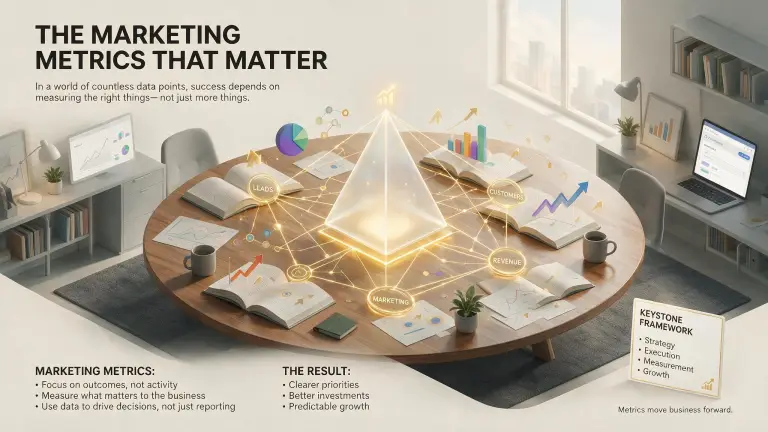
The Keystone Marketing Framework for Predictable Growth integrates ICP clarity into foundational strategy. Rather than expanding broadly, the framework emphasizes alignment first—ensuring positioning, targeting, and messaging operate cohesively before scaling execution.
When you define ideal customer profile within a structured framework, growth stabilizes.
Alignment precedes acceleration.
The Psychological Advantage of ICP Clarity
Prospects convert when they feel understood. If your messaging reflects specific challenges, priorities, and decision-making contexts, trust increases. Trust reduces hesitation. Reduced hesitation shortens sales cycles.
When you define ideal customer profile precisely, marketing transitions from persuasive to relevant.
Relevance drives conversion. Precision eliminates ambiguity.
Predictable Growth Begins With Precision
Conversion consistency is rarely accidental. It emerges from targeted positioning, aligned messaging, structured reporting, and cohesive execution.
If you struggle with fluctuating lead quality or inconsistent close rates, revisit whether you truly define ideal customer profile with clarity.
Broad marketing generates activity. Precise marketing generates momentum. Predictable growth begins with knowing exactly who you are for—and who you are not.
Frequently Asked Questions
What does it mean to define ideal customer profile?
To define ideal customer profile means identifying the specific characteristics, behaviors, and strategic fit of customers most likely to convert, retain, and succeed with your solution.
How is an ICP different from a buyer persona?
An ICP focuses on structural and strategic fit at the account or organizational level, while buyer personas typically describe individual decision-makers within that account.
Why is ICP important for conversion rates?
A clearly defined ICP improves targeting precision, messaging alignment, and qualification standards, which increases conversion efficiency.
How often should you revisit your ICP?
Review ICP alignment annually or whenever significant performance shifts occur. Refinement should be data-driven, not reactive.
Can ICP clarity improve SEO performance?
Yes. When ICP insights guide content and keyword strategy, digital visibility improves because messaging aligns directly with audience search intent.
Takeaways
Conversion challenges often trace back to targeting ambiguity.
When you fail to define ideal customer profile clearly, marketing becomes broad. Broad marketing increases cost, reduces clarity, and slows growth.
When you define ideal customer profile with precision, messaging sharpens. Sales alignment strengthens. Reporting improves. Conversion stabilizes.
Predictable growth is not about reaching everyone. It is about reaching the right ones—consistently. If your marketing feels active but inconsistent, start here.
Define your ICP. The rest will follow.