
If you’ve ever looked at your CRM and thought, “We have plenty of leads—so why aren’t they closing?” you are not alone.
It is one of the most common frustrations among growing businesses. Marketing appears to be working. Forms are being filled out. Downloads are happening. Meetings are being booked. Traffic may even be increasing. Yet revenue does not move proportionally.
The immediate assumption is that the issue must be volume. More leads will fix it. More traffic will correct it. More campaigns will solve it.
But the real question is not how to generate more leads. It is understanding why leads aren’t converting in the first place.
And more often than not, the answer is structural.
The Illusion of a Lead Problem
When conversions stall, organizations often default to tactical solutions. They increase ad spend. They launch additional landing pages. They test new channels. They refine subject lines. They invest in automation tools.
These adjustments can improve performance at the margins, but they rarely solve the core issue.
If you are consistently asking why leads aren’t converting, it is usually not a volume problem. It is a strategy problem.
Conversion issues typically trace back to positioning, alignment, messaging clarity, or qualification definitions—not lead generation itself. More input does not fix structural gaps.
Why Leads Aren’t Converting: The Strategic Disconnect
Let’s break down the most common structural reasons behind stalled conversions.
1. You Are Attracting the Wrong Audience
Traffic without precision is noise.
If your messaging is broad or your targeting lacks clarity, you may be attracting interest from individuals who were never ideal prospects. They may engage with content, download resources, or book introductory calls, but they are not positioned to buy.
This misalignment is one of the primary reasons why leads aren’t converting.
Conversion begins long before a sales conversation. It begins with intentional audience definition and positioning. Without it, marketing generates activity rather than qualified momentum.
2. Your Value Proposition Is Unclear
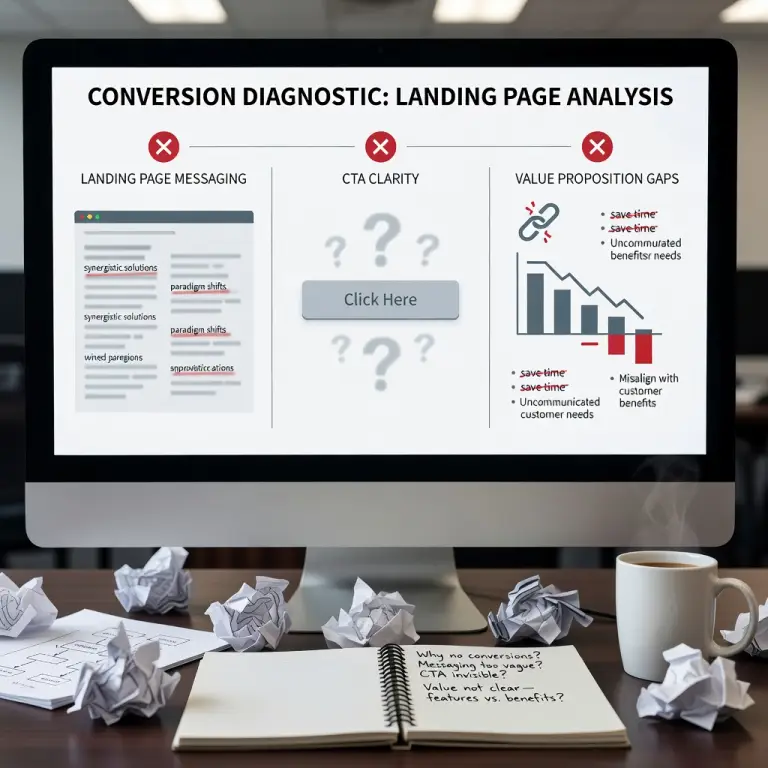
Even when leads match your target profile, they must quickly understand why your solution matters.
If your messaging focuses on features instead of outcomes, prospects hesitate. If differentiation is subtle rather than decisive, they delay. If your positioning sounds similar to competitors, urgency fades.
When businesses investigate why leads aren’t converting, they often discover that clarity—not capability—is the missing element.
A strong value proposition reduces friction. It communicates not just what you do, but why it matters uniquely.
3. Marketing and Sales Define “Qualified” Differently
Conversion breakdowns frequently occur at the handoff between marketing and sales.
Marketing celebrates a high number of MQLs. Sales questions the quality of conversations. Reporting becomes defensive instead of collaborative.
If teams do not share a unified definition of qualified leads, performance gaps emerge. Sales may pursue prospects who lack intent or readiness. Marketing may optimize for metrics that do not align with revenue outcomes.
Understanding why leads aren’t converting requires evaluating internal alignment—not just external performance.
4. The Buyer Journey Is Fragmented
Conversion is rarely a single decision. It is a sequence of reinforcing interactions.
If your content, email nurture sequences, landing pages, and sales conversations do not align cohesively, prospects experience friction. Messaging may shift between stages. Tone may vary. Promises may evolve.
Fragmentation creates hesitation.
When examining why leads aren’t converting, look at the entire buyer journey. Does it feel structured? Or does it feel reactive?
Predictable growth requires continuity.
5. Your Metrics Track Activity, Not Intent
It is easy to celebrate surface-level performance indicators. Increased traffic. Higher engagement. Strong open rates.
But these metrics do not necessarily correlate with buyer readiness.
If your analytics focus heavily on volume instead of intent signals, you may miss the true cause of conversion gaps. For example, high content downloads may reflect curiosity, not urgency.
When organizations ask why leads aren’t converting, they often realize they are measuring visibility rather than buying behavior.
Strategic reporting prioritizes pipeline contribution, conversion rate progression, and revenue alignment.
The Hidden Cost of Non-Converting Leads
Unconverted leads do more than stall growth. They drain efficiency.
Sales teams invest time in unqualified conversations. Marketing teams allocate budget to audiences unlikely to close. Leadership questions ROI and considers reducing spend.
Over time, this creates internal friction and slows momentum.
Understanding why leads aren’t converting is not just about fixing sales performance. It is about protecting resource allocation and organizational confidence.
Conversion clarity reduces waste.
Strategy Before Scale
When conversion challenges arise, scaling volume is rarely the answer.
Instead, revisit foundational questions:
- Is our positioning clearly differentiated?
- Are we targeting the right audience with precision?
- Do marketing and sales share qualification criteria?
- Is our messaging consistent throughout the buyer journey?
- Are we measuring the right signals?
If even one of these elements lacks clarity, conversion performance will fluctuate. This is why structured frameworks matter.
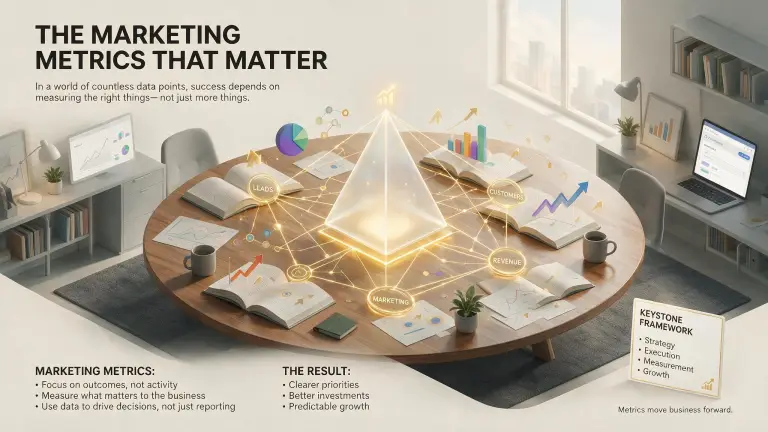
The Keystone Marketing Framework for Predictable Growth was designed to address the foundational gaps that explain why leads aren’t converting. Rather than adding more tactics, the framework strengthens positioning, aligns revenue objectives, and integrates measurement systems before scaling acquisition efforts.
When structure precedes expansion, conversions stabilize.
SEO, Authority, and Conversion
Conversion challenges also intersect with digital visibility.
SEO may increase discoverability, but discoverability alone does not guarantee revenue. Content must align with buyer intent, reinforce differentiation, and guide prospects clearly toward next steps.
Answer engine optimization (AEO) further requires structured clarity. If your content does not directly address buyer questions, provide organized responses, and reinforce authority, it may attract visitors without building conviction.
Sometimes why leads aren’t converting relates directly to content architecture.
Visibility without clarity produces interest without commitment.
The Psychology Behind Conversion
Conversion is fundamentally about trust and confidence.
Prospects evaluate risk before they evaluate features. They ask whether your solution addresses their problem clearly, whether your expertise is credible, and whether the investment feels justified.
If messaging lacks conviction, urgency declines. If proof points are vague, hesitation increases. If differentiation is subtle, comparison shopping extends.
When analyzing why leads aren’t converting, consider the psychological dimension. Does your messaging reduce uncertainty? Or does it require prospects to infer value?
Strategic clarity reduces hesitation.
Reframing the Lead Conversation
Instead of asking how to generate more leads, consider asking:
- Are we generating the right leads?
- Are we communicating value with clarity?
- Are we reinforcing trust throughout the journey?
- Are internal teams aligned around shared outcomes?
The answer to why leads aren’t converting often lies in strategic refinement rather than tactical expansion.
Growth accelerates when systems align.
Predictable Growth Is Engineered
Conversion consistency does not occur by chance.
It results from cohesive positioning, precise targeting, aligned teams, structured reporting, and unified messaging.
When those components operate independently, friction increases. When they operate within a defined framework, performance stabilizes.
Predictability is not about eliminating variability entirely. It is about reducing unnecessary volatility through alignment.
If you are questioning why leads aren’t converting, the solution is rarely another campaign.
It is usually stronger architecture.
Frequently Asked Questions
Why aren’t my leads converting even though traffic is high?
High traffic does not guarantee alignment. If positioning, targeting, or messaging lack clarity, leads may engage without purchasing intent.
How can I determine why leads aren’t converting?
Evaluate audience targeting, value proposition clarity, sales and marketing alignment, buyer journey cohesion, and reporting accuracy.
Do I need more leads if conversions are low?
Not necessarily. Scaling volume without correcting strategic gaps often increases inefficiency. Address structural alignment first.
Can better messaging improve conversion rates?
Yes. Clear differentiation and outcome-focused messaging reduce hesitation and increase buyer confidence.
How does a marketing framework improve conversions?
A structured framework aligns positioning, execution, reporting, and revenue objectives into a cohesive system that supports predictable growth.
Final Thoughts
Leads are not the problem. Misalignment is.
When marketing operates without cohesive structure, conversion rates fluctuate. Teams grow frustrated. Budgets expand without proportional return.
But when positioning is clear, targeting is precise, messaging is unified, and reporting aligns with revenue, conversion performance stabilizes.
If you are asking why leads aren’t converting, the answer likely lies beneath the surface.
Fix the strategy.
The leads will follow.