

Marketing often becomes more complicated as a business grows.
You add another campaign. Another platform. Another person. Another reporting dashboard. Another automation. Before long, there is a lot of marketing activity happening—but not necessarily a system connecting it all.
That distinction matters.
A growing business does not simply need more marketing. It needs a marketing operating system that determines how strategy moves into execution, how leads move through the funnel, how teams make decisions, and how results feed back into what happens next.
Without that structure, marketing becomes dependent on individual people, disconnected tactics, and constant intervention.
With it, marketing becomes repeatable, measurable, and much easier to scale.
What Is a Marketing Operating System?
A marketing operating system is the structure that connects your marketing strategy, people, processes, technology, data, and measurement into one repeatable way of operating.
It is not a single software platform.
It is not your CRM.
It is not your marketing automation platform.
And it is not your campaign calendar.
Those things can all be components of the system, but they are not the system itself.
Think about the operating system on a computer. Individual applications may perform specific tasks, but the operating system creates the environment that allows everything to work together.
Marketing needs the same thing.
Your strategy establishes where you are going. Your marketing operating system establishes how the organization consistently gets there.
That means answering questions such as:
- What are we trying to accomplish?
- Who are we trying to reach?
- Which marketing activities support those goals?
- Who owns each part of the process?
- How does a prospect move from first touch to qualified opportunity?
- What technology supports that journey?
- What data needs to be captured?
- Which metrics determine whether marketing is working?
- How do we use those results to make the next decision
When those answers exist only in people’s heads, you don’t have an operating system. You have institutional knowledge.
And institutional knowledge is difficult to scale.
Why Marketing Strategy Alone Isn’t Enough
A marketing strategy tells you what you intend to accomplish and, ideally, why.
But strategy without an operating structure creates a common problem: the plan looks great on paper, while daily execution slowly drifts away from it.
A business might establish a goal to increase qualified pipeline, for example. Yet the marketing team is measured on lead volume. Paid media optimizes toward form fills. Content focuses on traffic. Sales has its own definition of a qualified lead. The CRM doesn’t capture the information necessary to determine which campaigns influenced opportunities.
Everyone may be working hard.
The problem is that the work isn’t operating as a connected system.
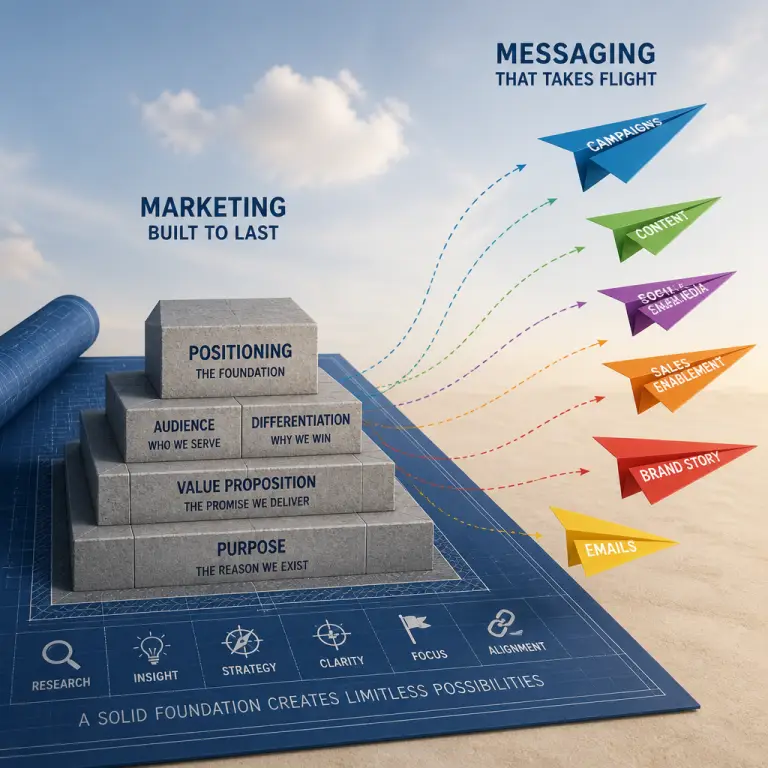
This is why the Keystone Marketing Framework for Predictable Growth begins with the foundation rather than jumping immediately into tactics.
Predictable growth requires more than execution. It requires clarity about where the business is going and structure around how marketing helps it get there.
Your marketing operating system is what makes that structure operational.
The 6 Components of a Strong Marketing Operating System
While every organization will build its system differently, six components should work together.
1. Strategy and Business Alignment
The operating system starts with the business—not the marketing calendar.
What does the organization need to accomplish?
That could mean generating a specific amount of revenue, entering a new market, improving customer retention, increasing pipeline, or expanding within existing accounts.
Marketing goals should then connect directly to those objectives.
This sounds obvious, but it is where many marketing organizations begin to disconnect. Marketing establishes its own goals, sales establishes another set, and leadership measures success through something entirely different.
A strong operating system creates a visible line from:
Business Goal → Marketing Goal → Campaign → Conversion → Pipeline → Revenue
When that line is clear, prioritization becomes much easier.
2. Audience and Customer Journey
Your system also needs to define who you are trying to reach and how those people move toward a buying decision.
That includes your ideal customer profile, audience segments, buyer needs, intent signals, buying stages, and key conversion points.
It should also account for what happens after someone converts.
- What makes someone a lead?
- What makes that lead marketing qualified?
- When should sales engage?
- What happens if the prospect isn’t ready?
- What happens when an opportunity closes?
Without these definitions, automation cannot solve the problem. It simply automates an undefined process faster.
A marketing operating system creates agreement around the journey before technology is asked to support it.
3. Processes and Workflows
This is where strategy begins becoming operational. Processes define how marketing actually gets done.
That includes campaign planning, lead management, content production, sales handoffs, nurture programs, reporting, approvals, and even how new marketing requests enter the team.
The goal is not to create documentation for the sake of documentation. The goal is to make important marketing processes repeatable.
If a campaign succeeds only because one person knows all the steps, you have a person-dependent process.
If another qualified team member can follow the same structure and achieve a comparable outcome, you are building a system.
That distinction becomes increasingly important as the organization grows.
4. Technology and Automation
Technology should support your process—not define it. Yet businesses frequently build their marketing in the opposite order.
They buy a CRM, automation platform, attribution tool, AI solution, project management platform, or analytics product and then try to reshape their process around what the technology can do.
That is how a martech stack becomes expensive without necessarily becoming effective.
Your marketing operating system should determine what technology is required, what each platform owns, how information moves between systems, and where automation removes unnecessary manual work.
The technology becomes infrastructure for the strategy.
Not the strategy itself.
This distinction is becoming even more important as AI enters more marketing workflows. AI can dramatically increase production speed, but increasing the speed of a disconnected process does not make the process more strategic. An operating model provides the context, governance, and workflows that allow automation and AI to create leverage instead of simply creating more output.
5. Data and Measurement
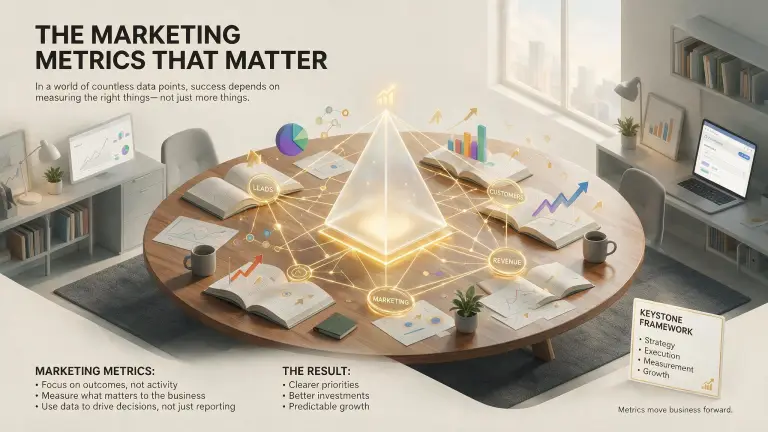
A marketing operating system also establishes what gets measured and why. This goes beyond dashboards. It means defining the data required to understand the entire marketing and revenue journey.
For example:
- Where did the prospect originally come from?
- What caused them to convert?
- Which campaigns influenced their journey?
- When did they become qualified?
- Did marketing create or influence an opportunity?
- Did that opportunity become revenue?
These questions require intentional data architecture.
If the fields, lifecycle stages, campaign structures, and attribution points are not established before reporting begins, the dashboard can look impressive while answering the wrong questions.
Measurement should not simply tell you what happened.
It should help you decide what to do next.
6. Optimization and Feedback
The final component closes the loop.
Marketing should not operate as:
Plan → Launch → Report → Start Over
It should operate as:
Plan → Execute → Measure → Learn → Optimize → Repeat
That feedback loop is what turns marketing activity into a system that becomes smarter over time.
You begin learning which audiences convert, which messages resonate, which channels influence pipeline, where leads stall, and where money or effort is being wasted.
Those insights then influence the next campaign, budget decision, workflow, or strategic priority.
That is where predictability begins.
Not because marketing becomes perfectly predictable—it never will—but because the organization develops a repeatable way to learn and improve.
Marketing Operating System vs. Marketing Tech Stack
These terms are sometimes treated as interchangeable, but they solve different problems.
Your marketing tech stack is the collection of technology you use.
Your marketing operating system determines how marketing operates.
For example, you might have:
- A CRM
- Marketing automation
- Google Analytics
- Paid advertising platforms
- SEO tools
- Project management software
- AI tools
- Business intelligence dashboards
That is a technology stack. But who owns the data? How are lifecycle stages defined? What triggers a nurture? When does a lead move to sales? Which source is considered authoritative? What happens when data conflicts? How is campaign performance connected to pipeline?
Those are operating-system questions.
Adding another tool rarely fixes them. In fact, without an operating structure, adding technology often creates another silo.
Signs You Need a Marketing Operating System
You may already have many pieces of a marketing system without having intentionally built one.
Some warning signs are easy to recognize.
Marketing priorities constantly change. Campaigns are created reactively. Reporting requires hours of manual work. Sales and marketing disagree about lead quality. Nobody completely trusts attribution. Technology platforms contain conflicting information. Critical processes depend on one employee. Leadership asks what marketing contributed to revenue, and the answer requires assembling information from multiple systems.
Another important signal is simpler:
Your marketing team is extremely busy, but it is difficult to explain how all that activity connects to growth.
That is usually not an effort problem.
It is a structure problem.
Why a Marketing Operating System Creates More Predictable Growth
Predictable growth does not mean knowing exactly how much revenue every campaign will generate.
It means creating enough structure to understand what is working, repeat successful processes, identify problems earlier, and make better decisions with the information you have.
A strong marketing operating system gives your organization that ability.
Instead of rebuilding the process every time you launch something, you have a framework.
Instead of relying on tribal knowledge, you have documented workflows.
Instead of debating definitions, you have shared criteria.
Instead of collecting technology, you have connected infrastructure.
Instead of reporting activity, you can begin connecting marketing decisions to business outcomes.
And instead of constantly asking, What should marketing do next? you can ask a much more valuable question:
What does the data tell us we should improve next?
That is a very different way to operate.
Where Should You Start?
Do not start by buying another platform. Start by mapping what already exists.
Document your business goals, marketing goals, customer journey, lifecycle stages, key processes, technology, data sources, handoffs, and reporting.
Then look for the gaps.
- Where does information stop moving?
- Where does ownership become unclear?
- Where are people manually compensating for a broken process?
- Where does sales lose visibility?
- Where can you not connect marketing activity to pipeline or revenue?
Those gaps show you where your operating system needs work. You do not have to rebuild everything at once. In fact, you probably shouldn’t.
Build the foundation first. Connect the highest-impact processes next. Automate only after the process makes sense. Then measure, learn, and continue improving the system.
Frequently Asked Questions About Marketing Operating Systems
What is a marketing operating system?
A marketing operating system is the connected structure that governs how a business plans, executes, measures, and improves marketing. It brings together strategy, people, processes, technology, data, and measurement so marketing can operate consistently and support measurable growth.
Is a marketing operating system software?
No. Software can support a marketing operating system, but the operating system itself is the broader structure connecting strategy, workflows, technology, data, ownership, and measurement.
What is the difference between a marketing operating system and a marketing strategy?
A marketing strategy defines what you want to achieve, who you want to reach, and how you plan to compete. A marketing operating system defines how that strategy is consistently executed, measured, and improved.
Does a small business need a marketing operating system?
Yes, although it does not need to be complicated. Smaller businesses often benefit significantly from establishing clear processes early because it reduces dependence on individual people and makes future growth easier to manage.
When should you build a marketing operating system?
The best time is before complexity becomes a problem. If marketing feels reactive, reporting is difficult, technology is disconnected, lead handoffs are inconsistent, or growth depends heavily on individual employees knowing what to do next, it is time to establish a more structured operating model.
Build the System Before You Add More
Businesses rarely suffer from a shortage of marketing ideas.
There is always another campaign to launch, platform to test, AI tool to explore, piece of content to create, or channel to pursue.
The harder question is whether all those activities are building toward the same outcome.
A marketing operating system creates the structure that makes that possible.
It connects strategy to execution, execution to measurement, and measurement back to better decisions.
Because predictable growth does not come from doing more marketing.
It comes from building marketing that works as a system.